Best Lower Facelift in Busan, Korea
T&T Plastic Surgery Seomyeon
Looking for a lower facelift in Busan, Korea? T&T Plastic Surgery Seomyeon offers customized lower facelift surgery for patients concerned about prominent jowls, sagging lower cheeks, loose skin, and loss of jawline definition.
A lower facelift specifically focuses on age-related changes affecting the lower third of the face, providing more direct surgical correction of sagging tissues than non-surgical lifting treatments.
What Is a Lower Facelift?
A lower facelift is a surgical facial rejuvenation procedure focused primarily on the lower cheeks, jowls, and jawline.
As facial tissues descend with age, excess skin and soft tissue can collect around the lower face, creating jowls and making the jawline appear less defined.
Lower facelift surgery is designed to reposition sagging tissues and carefully redrape loose skin, restoring cleaner and more youthful lower-face contours.
What Can a Lower Facelift Improve?
Lower facelift surgery may be considered for:
- Prominent jowls
- Sagging lower cheeks
- Loose lower-face skin
- Reduced jawline definition
- Lower-face heaviness
- Mild to advanced facial laxity
- Loss of V-Line contours
- Age-related tissue descent
- Loss of youthful lower-face definition
The surgical plan depends on the patient's facial anatomy and degree of sagging.
Lower Facelift for Jowls
Jowls are one of the primary concerns addressed with lower facelift surgery.
As cheek and lower-face tissues descend, they can accumulate along the jaw border and create a heavier, less defined appearance.
A customized lower facelift in Korea can reposition these tissues and address excess skin to create a smoother transition between the cheeks and jawline.
Lower Facelift for Jawline Definition
A youthful jawline typically has a relatively clean transition from the lower cheek toward the chin and upper neck.
Facial aging can blur this definition as tissues descend and skin becomes looser.
Lower facelift surgery can restore cleaner and stronger-looking jawline definition by addressing the underlying causes of lower-face sagging.
Lower Facelift for Sagging Skin
When lower-face laxity becomes more advanced, HIFU, RF, or thread lifting may no longer provide the degree of correction a patient wants.
Surgical lifting allows more direct repositioning of descended tissues and management of excess skin.
This makes a lower facelift particularly relevant for patients seeking more substantial correction of age-related sagging.
Lower Facelift vs Full Facelift
A lower facelift concentrates primarily on the lower cheeks, jowls, and jawline, while a full facelift may address a broader pattern of facial aging.
Patients whose main concerns are concentrated around the lower third of the face may not always require the same extent of surgery as someone with more widespread facial sagging.
The appropriate approach should be determined after evaluating the entire face.
Lower Facelift vs Mini Facelift
Both procedures can target lower-face aging, but the extent of surgery can differ.
A mini facelift is generally considered for earlier or more limited sagging, while a lower facelift may provide more extensive correction when jowls and loose lower-face tissues are more noticeable.
The procedure should be selected according to the amount of correction required rather than age alone.
Lower Facelift vs Thread Lift
Thread lifting uses absorbable threads to provide temporary support to mildly sagging tissues.
A lower facelift provides direct surgical repositioning and can address loose skin, making it more suitable when lower-face aging has progressed beyond what minimally invasive treatments can reasonably correct.
Both procedures have different indications, recovery periods, and expected degrees of improvement.
Lower Facelift and Neck Aging
Lower-face and neck aging frequently develop together.
When under-chin or neck laxity is also present, the relationship between the jawline, chin, and neck should be evaluated as part of the surgical plan.
Depending on individual anatomy, additional neck treatment may be considered to create more balanced rejuvenation.
Natural-Looking Lower Facelift
Lower facelift surgery should improve facial aging without creating an excessively tight or pulled appearance.
Careful tissue repositioning and skin redraping can restore lower-face definition while maintaining natural expressions and individual facial characteristics.
The goal is a firmer and refreshed version of the patient's own face.
Lower Facelift in Seomyeon, Busan
At T&T Plastic Surgery Seomyeon, your lower cheeks, jowls, jawline, skin laxity, tissue position, and overall facial proportions can be evaluated before surgery.
A customized lower facelift surgical plan can then be developed according to your anatomy, aging pattern, and desired degree of rejuvenation.
Lower Facelift Busan FAQ
What does a lower facelift treat?
A lower facelift primarily addresses sagging lower cheeks, jowls, loose lower-face skin, and reduced jawline definition.
Is a lower facelift good for jowls?
Yes. Jowls are one of the main concerns that lower facelift surgery is designed to improve.
Can a lower facelift improve my jawline?
Repositioning descended tissues and addressing excess skin can create a cleaner and more defined-looking jawline.
What is the difference between a lower facelift and full facelift?
A lower facelift concentrates on the lower third of the face, while a full facelift may address a broader pattern of facial aging.
Is a lower facelift better than thread lifting?
It depends on the degree of sagging. Thread lifting is generally suited to milder laxity, while surgery can provide more extensive correction.
Where can I get a lower facelift in Busan?
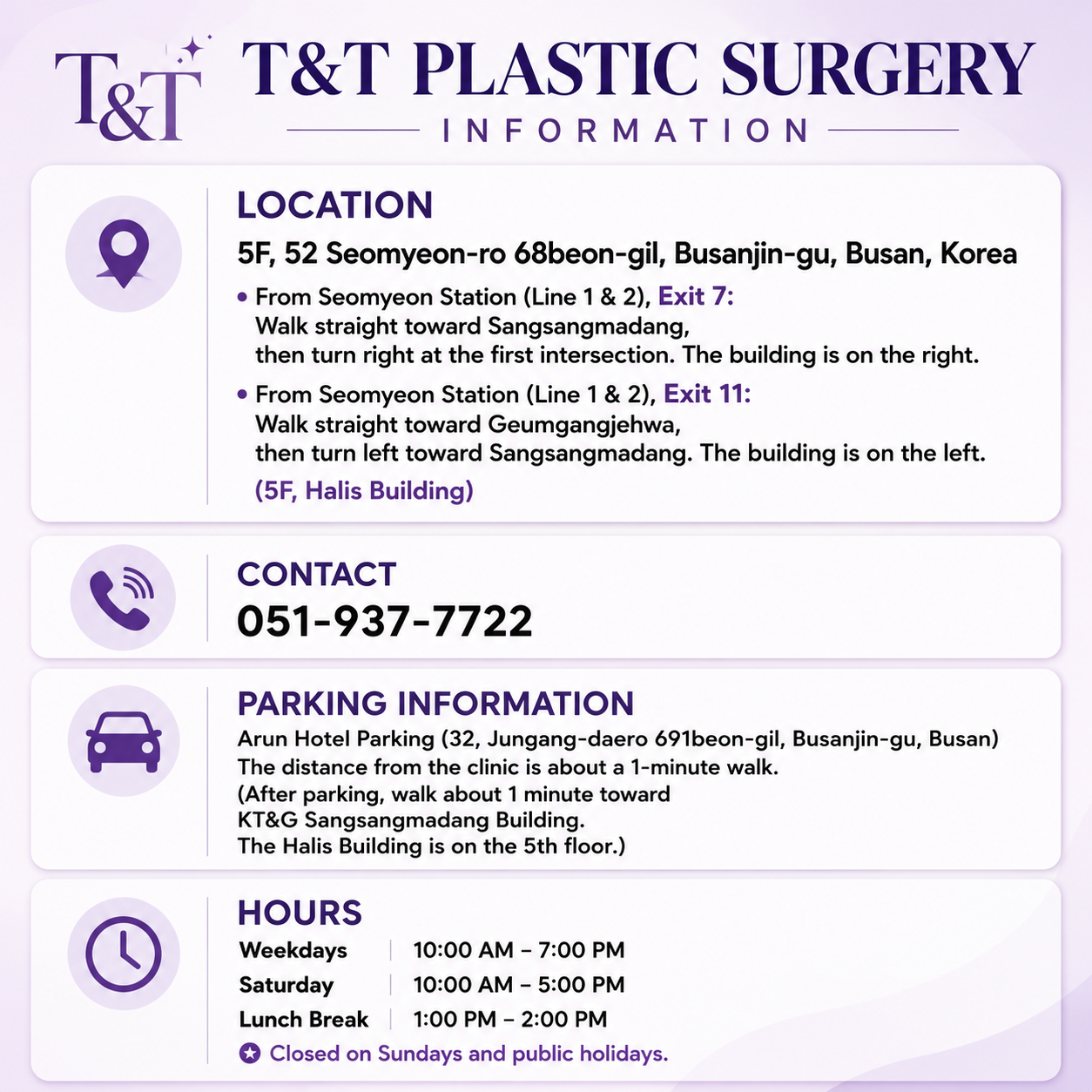
T&T Plastic Surgery is located in Seomyeon, Busan, offering customized lower facelift surgery for patients seeking improvement in jowls, sagging skin, and jawline definition.